
Thanksgiving Meal Totes (Food Pantry) In late November, we distribute non-perishable, complete Thanksgiving meals through our Food Pantry. These meal bags are distributed on a first-come, first-served basis. We recommend visiting our Food Pantry to register for regular food services in advance.
Thanksgiving Day Community Meals (Bridge Shelter) On Thanksgiving Day, Thursday, November 26, we will serve both a community lunch at 12:00 PM and dinner at 5:00 PM for the public in honor of the holiday. No advance sign-up is needed, and individuals as well as whole families are invited to join us for this special meal, prepared by our hardworking staff and volunteers.
Toys for Tots Distribution We are proud to serve as one of the Volusia County Toys for Tots distributing agencies, typically serving nearly 200 families each year through this event.
Important Registration Details: Families must register for Toys for Tots between October 1 and November 1, and meet the required qualifications.
Once registered, families are assigned to collect their toys from a specific location, which could be The Neighborhood Center, or another agency like the Police Athletic League, local churches, etc. The assigned pickup site will send their registered families instructions and details for collecting their toys. Families cannot visit multiple sites, and sites can only distribute toys to the families assigned to that site.
Click the link above for more information and to register through Volusia County Toys for Tots.
Santaland Toy Giveaway The Neighborhood Center also hosts our own toy giveaway event in which families with children present can meet Santa, enjoy cookies, cocoa, and activities, and receive toys. This is an event open to the public and does not require pre-registration or advance sign-up. Please Note: Children must be present for toys to be received. Specific details and times for this event will be posted to our social media(Facebook and Instagram) pages this fall.
Food Pantry Hours
Monday – Thursday
9 am – 4 pm (closed 12 pm – 1 pm for lunch)
Friday: 9 am – 12 pm
Contact Food Pantry: 386-734-8120, ext. 106
This institution is an equal opportunity provider.
Financial Assistance and Healthcare Referrals
Call for availability, or visit in person with the required documentation.
386-734-8120, ext. 106 or 103
434 S. Woodland Blvd.
Deland, FL 32720

We provide nutritious meals daily, ensuring that individuals facing homelessness have access to essential nourishment.
We are dedicated to supporting individuals and families experiencing hunger in our community, spanning DeLand and its neighboring cities. Our efforts involve providing various nourishing food items such as fruits, vegetables, meats, rice, pasta, and more.
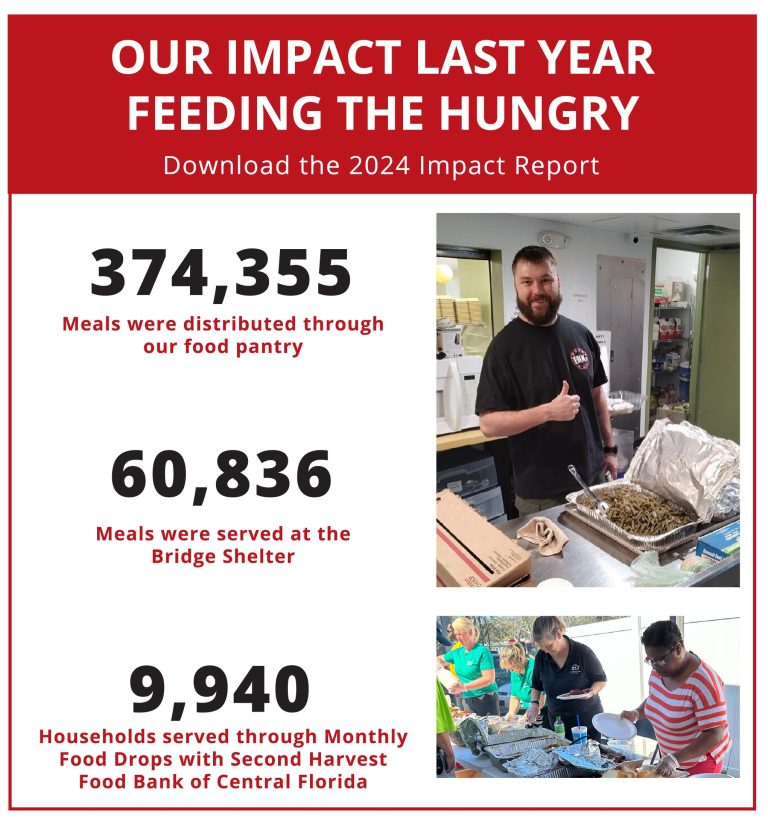
Our Bridge Shelter serves community meals daily to anyone needing a hot meal. Individuals and families are welcome to join us for lunches and dinners prepared and served by local community volunteers.
Monday – Friday
Lunch: Noon – 1 pm
Dinner: 5 – 6 pm
Saturday: Noon – 1 pm
Sunday: 1:30 – 2:30 pm
We partner with Second Harvest Food Bank of Central Florida to provide distribution of fruits, vegetables, meat, and dry goods to our community utilizing a drive-thru method of facilitation. Food Drops are held on the 2nd and 4th Tuesdays of each month, beginning at noon until all food has been distributed. Preregistration is not necessary to be a recipient. Times are subject to change.
This helps us ensure fair and widespread assistance. Emergency food is available for individuals without identification. Additionally, upon request, we distribute essential hygiene products such as shampoo, conditioner, toothpaste, toothbrushes, deodorants, and lotions, recognizing the importance of personal care.
We extend our support for families with children by offering items like diapers, formula, and baby food, acknowledging the unique needs of caring for children. Our mission also considers pets as we provide food for our furry companions.
Additional Food Assistance Resources are available to West Volusia residents.
Click here to see the list.
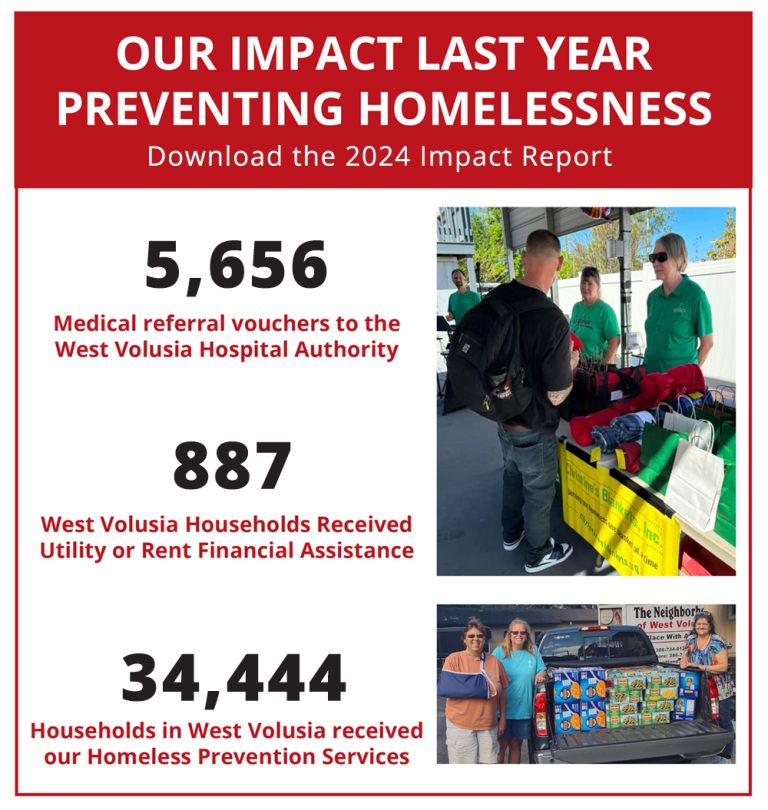
During 2025, our Food Pantry and Bridge Shelter distributed more than 376,000 meals to those in need. To sustain our emergency and daily food pantries, we continuously seek nonperishable food items for our pantry and ingredients to serve meals to 100 people for our Bridge meals. We can accept perishable foods with advanced notice to ensure proper refrigerated space. We welcome your food donations! Your contributions play a vital role in helping us address the ongoing needs of our community, ensuring that no one goes hungry.
The Following is a List of Suggested Items
Infants
Drop off Food Donations Monday – Thursday 9 am – 4 pm (closed 12 pm – 1 pm for lunch) at this address: 434 S. Woodland Blvd. Deland, FL 32720
Food Pantry Hours
Monday – Thursday
9 am – 4 pm (closed 12 pm – 1 pm for lunch)
Friday: 9 am – 12 pm
For more information, call
386-734-8120, ext. 106
This institution is an equal opportunity provider.
Mealtimes
Monday – Friday
Lunch: Noon – 1 pm
Dinner: 5 – 6 pm
Saturday: Noon – 1 pm
Sunday: 1:30 – 2:30 pm

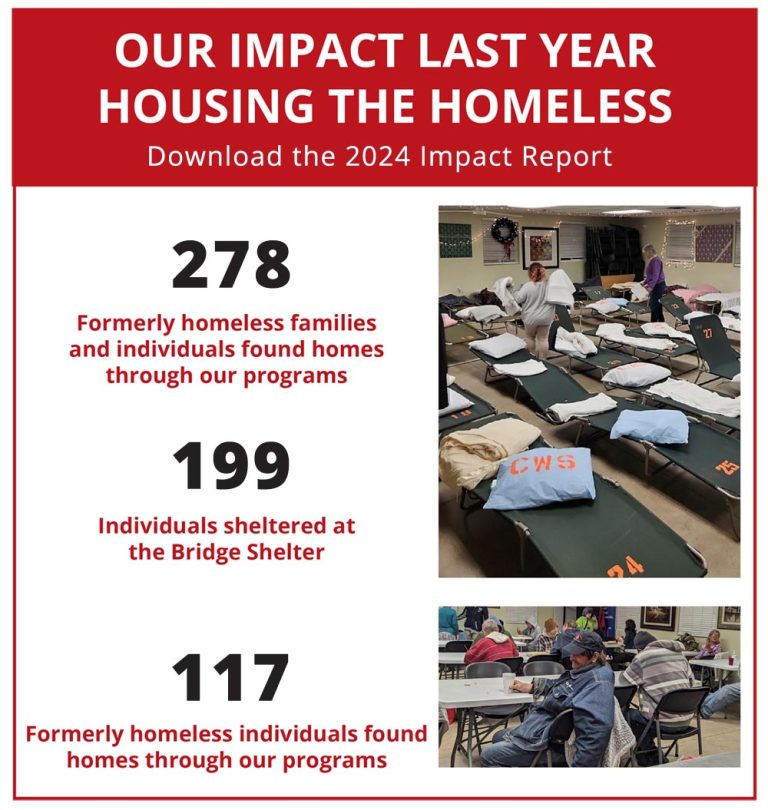
The Neighborhood Center has access to many housing programs for men, women, and families. Our housing department consists of 64 units serving over 200 individuals on any given day, including families, veterans, seniors, and individuals with disabilities.
Our residential accommodations are spread across West Volusia, comprising a mix of properties we own and units leased through collaborations with local landlords. Some of these partnerships function under a fee-for-service model, employing a sliding scale of affordability determined by a client’s income. Some are funded by HUD and other government grants and agencies, and each has its own set of requirements.
Our housing clients meet weekly with a caseworker to address stabilization efforts and formulate exit plans when appropriate. Case managers collaborate with residents to achieve personalized service goals, focusing on employment and fostering a secure living environment.
Having trouble with unhandled repairs or unsafe living conditions? Explore our Tenant Rights Guide for clear action steps and local legal aid resources.
Download Neighborhood Center Housing Map Locations
We provide 47 transitional housing beds in West Volusia. Transitional housing is intended to bridge the gap from a crisis — such as abuse or homelessness — into permanent housing. Transitional housing is more private than emergency shelter; it offers a safe space in which people can process their trauma, work on the issues that led to their homelessness, and build a supportive network that will help them in the future. On average, an individual will stay in transitional housing for one year.
Our 64 Permanent Supportive Housing beds provide long-term, affordable housing and support services to people with disabilities or other special needs who are homeless or at risk of becoming homeless. The services are designed to build independent living and tenancy skills and connect people with community-based health care, treatment, and employment services. PSH is considered a Housing First principle, meaning there are no preconditions (e.g., sobriety, enrollment in mental health services, etc.) for program participants to access housing.
Rapid Re-housing is a brief rental assistance service aimed at swiftly securing housing for individuals, fostering self-sufficiency, and promoting housing stability. The objective of offering monthly financial support is to transition clients into long-term stability following their exit from the program.
These are housing programs geared toward special populations:
The Domestic Violence (DV) Rapid Rehousing program is dedicated to aiding individuals escaping domestic violence situations in acquiring affordable and secure housing within the community. This initiative provides participants with financial assistance for up to 2 years, supporting stabilization efforts and funding to facilitate their transition to safety and stability.
Opened in the Summer of 2024, this facility offers shelter for 60 to 90 days to accommodate 5 families up to 5 household members. The congregated living space features private bedrooms and shared common areas. Residents have access to all Neighborhood Center support services, including case management, to facilitate their journey toward permanent housing. Learn more .
GAP is a post-release substance abuse transitional housing program that houses 12 men. This program was established through collaboration with the Florida Department of Corrections (FDOC). Upon release from incarceration from any Florida prison within the past 365 days, released inmates are eligible to reside in this facility for community reintegration.
The Lacey House was established through funding by The Lacey Family Foundation and is specifically designed to accommodate women and women with children. The house features four suites, enabling the reunification of mothers and children while receiving comprehensive support services provided by the agency.
The STEPS Program is a six-month recovery initiative providing a supportive environment for eight individuals committed to sobriety. Through a structured three-phase process, participants rebuild life skills, master money management, and develop coping strategies. The program is designed to address the unique challenges of recovery, fostering successful and independent reintegration into the community. Learn more .
Housing Service Hours
Monday – Thursday
9 am – 4 pm
(closed 12 pm – 1 pm for lunch)
Friday: 9 am – 12 pm
For more information, call
386-734-8120, ext. 502
Since September 2020, The Bridge has stood as a beacon of hope and vital resource in the heart of DeLand, offering an essential pathway from crisis to stability for unsheltered single adults. Owned and funded by the City of DeLand and operated by The Neighborhood Center of West Volusia (NHCWV), this multi-purpose facility thrives on deep community collaboration and dedicated volunteer support. In addition to serving as an emergency shelter for 14 women and 16 men, The Bridge acts as a daytime community center providing daily meals, hot showers, and laundry facilities, as well as an overnight refuge during extreme weather conditions.
What truly sets The Bridge apart is its unwavering commitment to holistic, dignity-centered care. Residents are provided with rigorous case management, housing transition support, healthcare access, and employment resources, while being required to work toward long-term employment. To learn more about The Bridge offerings and resources visit The Bridge Shelter Information Page.
OPEN 24 HOURS
421 S. Palmetto Ave.
DeLand, FL 32720
For more information, call
386-734-8120, ext. 601